A Brief History of the Malvern District.

 For up to 40-thousand years the Kulin people lived as hunter-gatherers on land which later became Malvern.

An estimated population of fewer than 20-thousand people of three tribes occupied the fertile land around the Melbourne district.

However the lives and futures of the Wurundjeri, Boonwurrung and Wathaurong tribes were changed forever with the arrival of European settlers in 1835.

Their numbers soon decreased due to diseases introduced by the newcomers.

Other factors which contributed to their decline included mistreatment, alcoholism , venereal diseases and skirmishes over land disputes.

With unrelenting Euopean settlement of the Melbourne area, the remaining Aboriginal people were granted "Permissive Occupancy" of land near Healesville in 1863 and were forcibly resettled there.

During the 1850s development of Melbourne spread east, south and north.The wealthy suburbs of South Yarra, Toorak, Kew and Malvern were established, while working people lived in the suburbs of Richmond, Collingwood and Fitzroy.

Malvern is located about 9 kilometres (6 miles) southeast of Melbourne, the capital city of Victoria. Covering an area of 15.88 square kilometres ( 6.13 square miles) the City of Malvern existed from 1856 until 1994.

Malvern was incorporated as the Gardiner District on 17 October 1856, which became the Shire of Gardiner on 25 May 1871. It was renamed Shire of Malvern on 15 February 1878, became a borough on 22 February 1901, a town on 24 April 1901 and a City on 30 May 1911.

On 22 June 1994 the City of Malvern was abolished and merged with Prahran to create the City of Stonnington.


The following table of events in the early history of Malvern is based on a more extensive list prepared by the Malvern Historical Society:


1837
John Gardiner selected a cattle run in the area and built a house just north of the junction of the Yarra River and Kooyong Koot Creek (later to be known as Gardiners Creek).

1839
James McAlpine settled in the area.

1840
The first sale of Crown Land occurred on 10 June; four lots, with a total of 245 acres extending south from Kooyong Koot Creek (Gardiners Creek) were sold.

 1849
The second sale of Crown Land occurred on 27 June, in the area bounded by Kooyong Road, Gardiners Creek Road (now Toorak Road), Malvern Road and Tooronga Road.
 

1854
Land Sales in
Gardiner Township. First school began in a four-roomed cottage in Malvern Road.

1856
Inception of the
Gardiner District Road Board. The boundaries of the first District (Kooyong Road, Gardiner’s Creek, Warrigal Road and Dandenong Road) have always remained the same. First road works started by the Road Board - the construction of Malvern Hill Road (later called Hopetoun Road) A public auction was held on 27 November. 90 lots owned by Charles Skinner, were described in the auction advertisement as ‘Freehold properties in the
Township of Ledbury, Parish of Prahran, Malvern Hill Estate’.

1857
A government grant was obtained for the construction of a non-denominational School building in Glenferrie Road
for the Anglican Church.

1858
Holy Trinity Church built at the corner of Dandenong and Warrigal Roads, the first permanent brick church in the former City of Malvern.

1864
First toll house erected on Scotchman’s Creek Road (later known as Waverley Road) by the Road Board.

1869
First water pipe supplied water to a part of the town from the Yan Yean Reservoir.

1871
Gardiner Road Board became the Gardiner Shire Council. According to the Melbourne
Directory the population of the Gardiner District numbered about 68 persons.  

1873
James Munro (President of the Shire Council) moved that council employees should only have to work an eight hour day (present rate was 9 hours for a wage of 6/-); his motion was defeated, it was regarded as too revolutionary.

1875
Spring Road State School opened in a new two-roomed brick building.  

1878
Name of Gardiner changed to Malvern.

 1879
First train (steam) passed through Malvern Station.

1884
First asphalt footpath laid in Malvern.

1885
Hon Alfred Deakin laid the foundation stone of the Shire Hall.


1886
Official opening of the Town Hall (Shire Hall).

1888
Malvern Gardens laid out by Thomas Pockett.

1889
At the beginning of this year it was recorded that in the past twelve months Malvern’s rateable property had increased in value by 62,000 pounds. The Shire Hall was extended in a northerly direction and the second tower built.

1890
Stonnington built for John Wagner. Railway line extended from
Burnley
to Glen Iris. Malvern Gardens officially opened by Duncan Gillies, MP.

1891
The southern tower of the Town Hall was redesigned and strengthened to contain a clock, a gift from the Shire President, Cr Alex McKinley.

One hundred notable Melbourne men formed the Melbourne Golf Club and obtained permissive occupancy of two pieces of land in East Malvern for an 18 hole golf course. The Club moved to Black Rock in 1901 and the course was taken over by the Caulfield Golf Club, later Metropolitan Golf Club.

1900
Demonstration at Malvern’s Town Hall to support Women’s Suffrage.

1901
Sir George Sydenham Clark became the first of the Victorian Governors to take up residence at Stonington
. Malvern Progress Association formed. Malvern became a Borough in February and a Town in April.

1907
State Parliament passed the Prahran and Malvern Trust Constitution Bill opening the way for tramway construction. Land acquired by Council for Central Park
.

1910
First tram lines opened in Malvern, first tram car left the depot in Coldblo Road
on 30 May.

1911
Malvern declared a City. Inauguration of the Malvern Municipal Band. Tooronga Progress League formed.
 
Land acquired by Council for Hedgeley Dene Gardens.

1912
 
Vincent Wickenton moved into 48 Hunter Street with his parents and two sisters.

1914
Outbreak of World War I.
Malvern organizations, especially Red Cross, began patriotic war work which continued for the next four years.

1919
Influenza epidemic, over 2,000 cases in Malvern.

1920
Kooyong Tennis Courts became the home of the Lawn Tennis Association of Victoria.

1922
Electrification of railway line.

1924
Mayor opened a begonia show using wireless, a first in Australia
.

1926
Portico added to the
Malvern Town Hall.

1927
Municipal Swimming Pool opened (on the site of the present Harold Holt Swim Centre).

1928
Malvern Baby Health Centre opened in Barkly Avenue.  

1930
Beginning of economic depression. 800 local families were on Government sustenance, 14% of population. Railway line extended from East Malvern
to Glen Waverley.

1931
The last of the Governors to live at Stonnington. Lord Somers in residence June 1926 - June 1931.

1934
Large area in vicinity of Gardiners Creek severely flooded and
Toorak Road
bridge swept away.


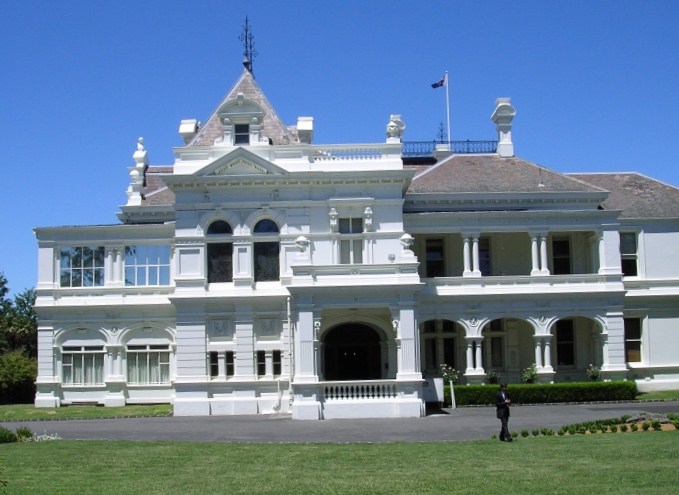
Photo: Wikipedia Commons 


Malvern has many mansions, but probably none better known than Stonnington  (above). The house was built in1890 for John Wagner, a partner in Cobb and Co coaches.

Melbourne became the location of the Commonwealth Government following Federation in 1901.

Government House , Melbourne, then became the home for the Governor General and the Victorian Government bought Stonnington as a home for Governors of Victoria. The mansion fulfilled that role until 1931.

The City of Stonnington  derives its name from the property.

                                                           Page 17

                                   To Return To Start Click Image Below.                                                                                                           

                         OTHER SITES TO VISIT 

If you have enjoyed this website, you may like to visit some more of my sites. I have a site   

BEAUTIFUL BROGO

which has a webcam still picture, updated a few times each day, plus

other photos from our  place at Brogo NSW         Click The URL Below to Go There

http://www.mycampage.com/beautifulbrogo

Another website, In A Garden At Brogo  shows the various flowers, trees and shrubs growing in a

garden at Brogo NSW.                                Click on URL Below to Visit The Garden   

                                                                                                   http://inagardenatbrogo.weebly.com/

 Another website for Nostalgia Buffs is SNAPSHOTS 1952

which has photos  taken with a

Kodak Box Brownie in Britain, Ireland, Continental Europe and ports of call between Australia and

England  in 1952  .                      Click the site's URL Below to Go There                                                                                       http://snapshots1952.weebly.com/  


A website honours an outstanding Australian for his work as a teacher and as a soldier in WW2. Arthur Beaumont Shannon was a Rat of Tobruk. You can reach the site by clicking the URL:  http://alifeofservicearthurbeaumontshan.weebly.com/


Visit a website to see photos of people and places as they were in the years from 1948 to 1951 in South East Australia. Click on this URL to go there.  http://seaustraliamemories1948-51.weebly.com/

This free website was made using Yola.

No HTML skills required. Build your website in minutes.

Go to www.yola.com and sign up today!

Make a free website with Yola